


For years, I’ve coached startup founders on how to pitch angel and venture capital investors. The basic storyline is fairly consistent. There is a problem in the world, and it is costing a particular group of customers time, money, lives, efficiency, or opportunity. The company has a solution to that problem, and the product or service creates measurable value for the customer. There is a large enough market to build a meaningful company, the team knows how to reach those customers through a specific go-to-market strategy, and there is some combination of IP, technology, network effects, business model or other competitive advantage that creates a moat. The company then shows what the financial model looks like over the next five years, explains how it could become valuable enough to attract a strategic acquirer, introduces the team that can execute the plan, and ends with a specific financing ask tied to value-creating milestones.
At its core, the startup pitch is a logical progression from problem to solution to investor return. As I have been studying and learning more about film investing, I started wondering how much of that framework translates to a film pitch. At first, the comparison seems awkward. A narrative film usually is not solving a “problem” in the traditional startup sense. Nobody wakes up in the morning saying they desperately need another romantic comedy or horror film. But the more I think about it, the more I realize that the underlying investor questions are remarkably similar. The language changes, and some of the economics are different, but the logic of the investment case does not change very much.
For a film, the equivalent of the startup “problem” is really the question: Why this film, for this audience, in this market, right now? The opening should establish a market thesis rather than inventing a customer pain point that does not exist. There may be demonstrated demand for low-budget horror, a reliable market for holiday films, a genre that travels particularly well internationally, or an identifiable audience around existing intellectual property. A particular actor, director, producer or underlying property may materially improve the prospects for distribution. A social or cultural trend may also make a story unusually timely. The investor should not simply hear, “We have a great idea for a movie.” The stronger case is, “There is a demonstrated market for projects like this, here is the evidence, and this film has been designed and packaged to participate in that opportunity.” That serves much the same purpose as establishing the market opportunity in a startup pitch.
Ready to Become a Better Angel Investor?
Reading about angel investing is a great start. Learning how to actually evaluate deals, conduct due diligence, understand term sheets, build a portfolio, and assess exit strategies is where the real learning happens.
Once that context has been established, the film pitch has to do something that most startup pitches do not: make the investor emotionally want the product. There should be a clear, concise concept or logline, followed by enough of the storyline to understand the characters, conflict, stakes and tone. This portion can and probably should be more visual and emotional than a typical startup pitch, because film is an emotional medium. At the same time, there is a real danger in spending ten minutes explaining the story and thirty seconds explaining the investment. The creative pitch has to make me want to watch the movie; the investment pitch has to make me want to finance the movie. Those are related, but they are not the same thing. I can’t tell you how many startup pitches I’ve seen where I would buy the product, but would never invest in the company.
One of the most useful parallels with venture investing is the distinction between who is the audience and who is the customer. The audience might be women aged 25–54 who regularly watch holiday romances, horror fans in a particular demographic, families looking for seasonal content, or an existing fan base around a book, game or franchise. But the economic customer may be quite different: a streamer, television network, theatrical distributor, international sales company, AVOD platform, broadcaster or some combination of these. That distinction mirrors something we often talk about with startups as the “second customer” theory of exit strategy. A startup has its operating customer today, but if investors are expecting an eventual acquisition, there is another customer in the future: the strategic buyer who may purchase the company. Good startup strategy considers both. Film investors should think similarly. The audience creates demand for the content, but there is also a commercial buyer or distributor that determines how that demand becomes revenue.
Comparable films then become something like the film version of competitive and market analysis. Unfortunately, film comps are sometimes used only as shorthand for the creative concept: “It’s Oppenheimer meets Barbie,” or some other familiar combination. That may help describe tone, but it does not tell an investor much about the investment case. Useful comps should help establish economics. What films with similar genres, budgets, talent profiles and audiences have recently been produced? What did they cost? How were they distributed? What did they sell for or gross? What characteristics made them commercially successful or unsuccessful? The point is not to argue that because another $2 million horror film made $50 million, this one will do the same. The point is to give investors a rational framework for understanding the range of possible outcomes.

The film equivalent of a startup go-to-market strategy is distribution, and this is probably one of the areas where many film pitches are weakest. Startup investors would never accept a plan that amounts to, “We’ll build the product and then figure out how to sell it,” yet the film equivalent can sometimes sound remarkably similar: “We’ll make the movie, submit it to some festivals, and hopefully Netflix buys it.” That is not a distribution strategy. A credible film pitch should explain the intended path from completed film to revenue. Will the project pursue a sales agent? Festivals? Domestic theatrical distribution? Streaming acquisition? International rights? Broadcast? Transactional video? AVOD or FAST channels? Pre-sales? The exact mix will differ by project, but the investor should be able to understand the chain from production to delivery to distribution to revenue in much the same way a startup investor expects to understand the chain from product to go-to-market to customer to revenue.
Join Our Next Angel 501 Workshop
Ready to take the next step? Join us for RVC Angel 501, our hands-on workshop designed to help investors build the practical skills and frameworks needed to evaluate early-stage investments with greater confidence.
Register for the next Angel 501 workshop → https://rockiesventureclub.wildapricot.org/event-6703036
Missed the upcoming session? No problem. View the RVC event calendar for the next Angel 501 workshop and other investor education opportunities.
The financial discussion also changes. A venture-backed startup is usually expected to show a five-year operating model with revenues, expenses, EBITDA or cash flow, hiring requirements and future financing needs. A film is primarily a discrete project, so the investor needs to understand the production economics instead. What is the total budget? Where will the money go? What capital has already been committed? Are there tax incentives, pre-sales, producer equity, debt or other financing sources? How much investor equity remains to be raised? Most importantly, does the financing actually get the film completed? If a movie costs $3 million, I want to understand how the entire $3 million is being financed, not simply hear that the producers are currently raising $1 million. The pitch should also make clear whether the stated budget gets the film through production, post-production and delivery, how much contingency is included, and whether marketing and distribution expenses are included or expected to be funded elsewhere.
The way investors get paid is another major difference between startup and film investing. Venture investors generally make money through an increase in enterprise value followed by an exit. Film investors generally make money through the monetization of a specific asset. That means the film pitch needs to explain the revenue waterfall clearly. Gross revenues come in, distribution fees and allowable expenses are paid, investors may receive their invested capital back, there may be a preferred return or premium, and remaining proceeds may then be split between investors and producers according to the deal terms. Whatever the structure is, it should be made understandable on a slide rather than requiring investors to reconstruct it from legal documents.

I also think films are better suited to scenario analysis than to the kind of hockey-stick projection we often see in startup pitches. Show the investor a downside case, a base case and an upside case. If I invest $100,000, what happens under each of those scenarios? How much revenue does the project generate, how much comes back to me, and on what timeline? That makes the discussion much more concrete and turns the presentation from a creative pitch into an actual investment discussion.
Time to cash also deserves more attention than it often gets. A production schedule is useful, but investors care about the full investment cycle. The relevant timeline is investment, pre-production, production, post-production, delivery, distribution, first revenues and potential investor recoupment. Film may have a very different duration profile from venture capital, where investors routinely wait many years for liquidity. That can be an attractive feature of the asset class, but only if the investor understands the likely timing and the risks that can delay or reduce distributions.

Finally, the ask should be specific. “We are raising $2 million” is not enough. A better close would explain that the total project budget is $3 million, $1 million has already been committed through producer capital, incentives or other sources, the project is raising $2 million of investor equity, the minimum investment is $50,000, the investment is being made into a specific project entity, and the financing fully funds the approved production plan through delivery with an appropriate contingency. And don’t forget the State economic development tax incentives that can make a seriously material positive impact on film investment returns. That gives the investor something concrete to evaluate and also answers one of the most important questions: whether this financing actually gets the project to completion.
When the two models are placed side by side, the similarities become much clearer. A startup pitch moves from Problem → Solution → Market → Go-to-Market → Competitive Advantage → Financial Economics → Exit → Team → Ask. A film pitch might move from Market Opportunity → Concept and Story → Audience → Distribution → Differentiation and Comparables → Project Economics → Investor Recoupment → Team and Package → Ask.
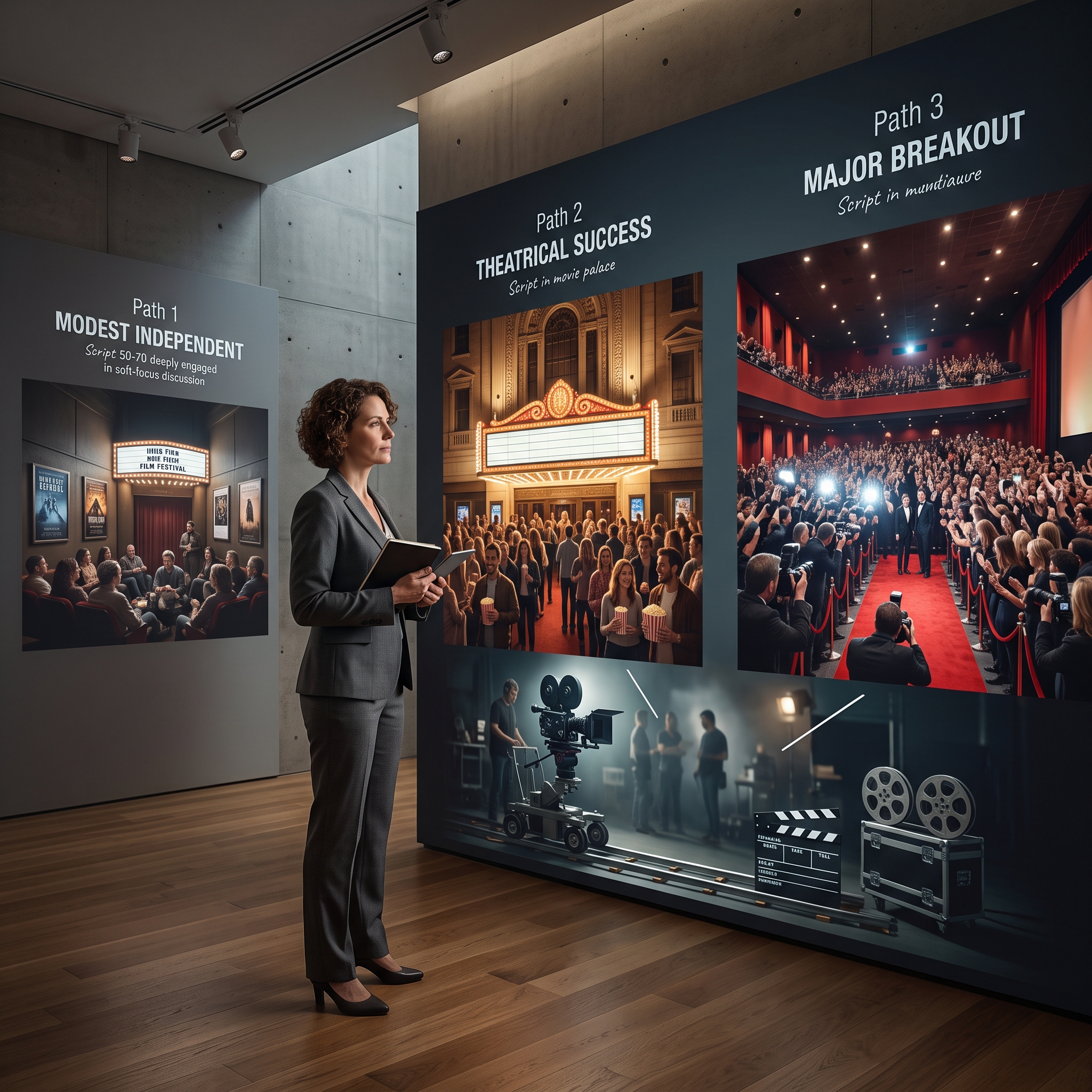
Underneath those two structures, however, investors are really asking many of the same questions. Why this opportunity? Why this solution or project? Who wants it? Who pays for it? How will you reach them? Why will this one succeed versus the alternatives? What are the economics? How do I get my money back and make a return? Why is this the team that can execute? And what exactly are you asking me to invest?

That, I think, is the useful bridge between venture investing and film investing. Film investors should not expect filmmakers to pitch their projects as though they are SaaS companies, and filmmakers should not assume that convincing someone a movie will be great is the same thing as demonstrating that it will be a good investment. A successful film investor pitch has to do both: the creative pitch makes me want to see the movie, while the investment pitch makes me believe there is a disciplined path to making money from it.
Want to Go Deeper?
Become an RVC Investor Member and get access to investor education, deal flow, investor forums, due diligence opportunities, and a community of experienced angel investors.
Explore RVC Membership → https://member.rockiesvc.ai/
Whether you're just getting started or looking to sharpen your existing investing process, RVC can help you become a more disciplined, informed, and connected angel investor.

.jpg)
.jpg)

