


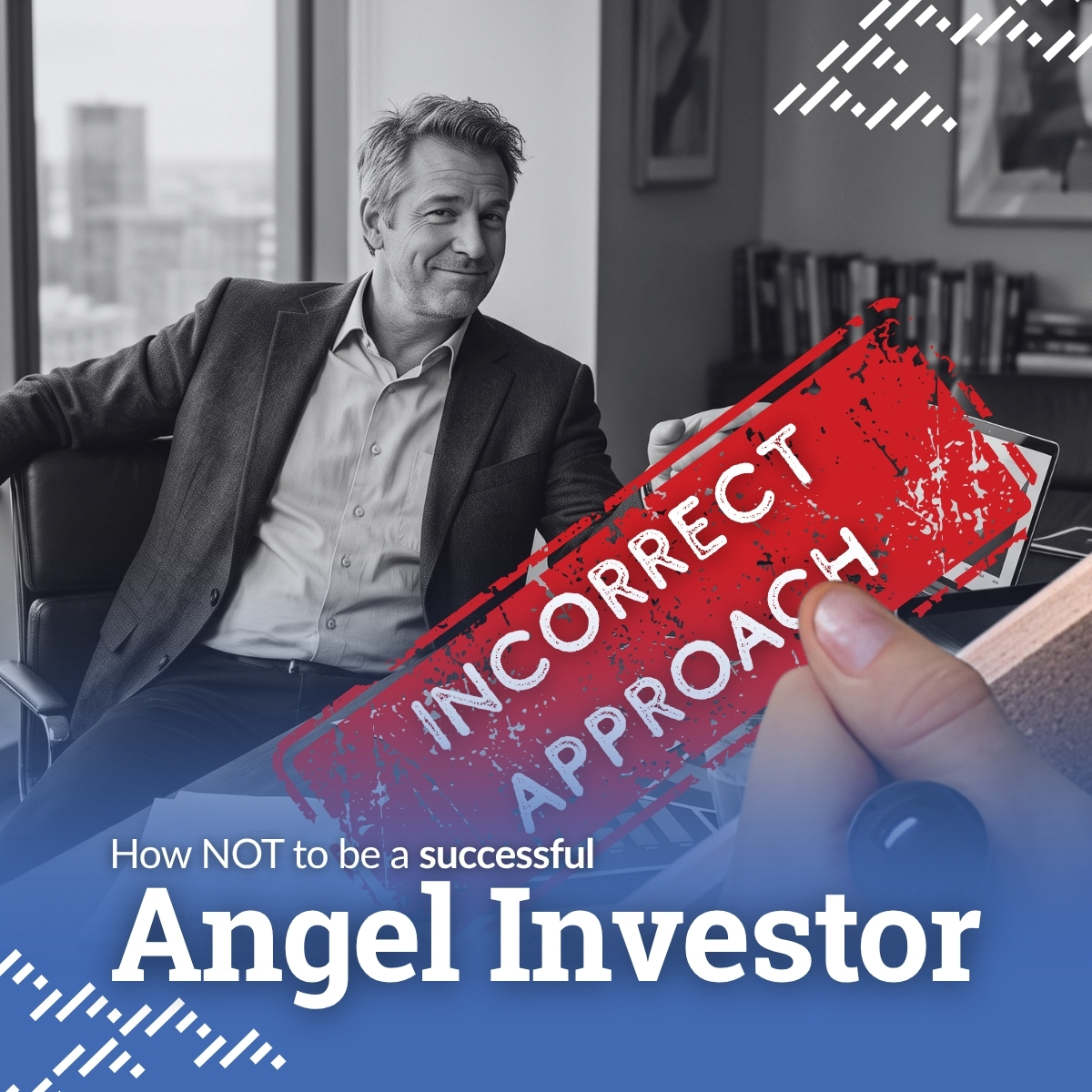
I’ve read plenty of books, articles, and blogs about how to be an angel investor. Yet despite the authors’ best intentions, I still see people entering angel investing and going about it all wrong. So, for those determined to learn the hard way, here’s a brief series of tips for achieving failure as an angel investor.
To NOT be a successful investor, invest like the sharks on Shark Tank. Offer ridiculously low valuations, take ridiculously large percentages of equity, and make promises about connections that may or may not materialize. The sharks themselves have acknowledged that many of their Shark Tank investments don’t work out. That’s not surprising when an investor takes so much equity that there’s little room left for future investors, potentially strangling the company’s ability to raise the capital it needs to succeed.

To NOT be a successful investor, invest alone. Why bother joining an angel group? After all, investing with a group would give you access to better deal flow, collaborative due diligence, diverse expertise, and deeper analysis than most investors can produce on their own.

To NOT be a successful investor, make just one or two angel investments and see how it goes. A diversified portfolio of 10–25 companies would only spread your risk and increase the likelihood that one or more successful investments can drive overall portfolio returns.
To NOT be a successful investor, don’t bother with due diligence if the investment is small. Research has shown that greater diligence effort can significantly improve investment outcomes. And diligence isn’t just about finding “bad stuff.” Good diligence can also sharpen a company’s strategy, identify risks and opportunities, and help prepare the company to accelerate once the investment round closes.

To NOT be a successful investor, ask plenty of questions about the product, but don’t confuse the issue by asking about the exit. It’s a classic newbie mistake to get excited about a startup simply because it has a great product. A great product is not the same thing as a scalable company—or an investable one. Experienced investors understand that the exit is ultimately when investors realize their returns, so thinking about who might acquire the company, why, and when matters from the beginning.

To NOT be a successful investor, don’t negotiate the term sheet. It’s going to be a unicorn anyway, so you should just feel lucky to get into the deal. Of course, if you really believe it could become a unicorn, perhaps you should negotiate even more carefully. At a $1 billion outcome, every additional 1% of ownership represents $10 million in value.
To NOT be a successful investor, rely primarily on your small-business experience and gut impressions when making investment decisions. Venture capital and angel investing operate under a very different set of rules, economics, and objectives from traditional small businesses. We call this “venturenomics.” Applying small-business investing logic to venture-scale startups is a reliable path to underperformance.
I hope these are useful. Seriously, I see these mistakes all the time. The more investors understand how angel investing actually works, the better their chances of generating strong returns—and the more successful startups we’ll be able to fund.
Ready to Become a Better Angel Investor?
Reading about angel investing is a great start. Learning how to actually evaluate deals, conduct due diligence, understand term sheets, build a portfolio, and assess exit strategies is where the real learning happens.
Join Our Next Angel 501 Workshop
Ready to take the next step? Join us for RVC Angel 501, our hands-on workshop designed to help investors build the practical skills and frameworks needed to evaluate early-stage investments with greater confidence.
Register for the next Angel 501 workshop → https://rockiesventureclub.wildapricot.org/event-6800569
Missed the upcoming session? No problem. View the RVC event calendar for the next Angel 501 workshop and other investor education opportunities.
Want to Go Deeper?
Become an RVC Investor Member and get access to investor education, deal flow, investor forums, due diligence opportunities, and a community of experienced angel investors.
Explore RVC Membership → https://member.rockiesvc.ai/
Whether you're just getting started or looking to sharpen your existing investing process, RVC can help you become a more disciplined, informed, and connected angel investor.

.jpg)

.jpg)

