


Startup founders seeking capital often find themselves navigating a complex landscape of funding options, frequently asking "Should I approach angel investors or venture capital funds?" without fully understanding how to make that critical choice. The decision can significantly impact your company's trajectory, so let's break down the key differences to help you determine which path aligns best with your startup's current stage and future goals.
Understanding the Fundamentals
At the highest level, venture capital funds are typically backed by institutional investors who seek outsized returns, while angel investors are individual private investors who also pursue significant returns: but often with smaller investments and shorter time horizons. However, this simple distinction only scratches the surface of a much more nuanced relationship between these two funding sources.
VCs generally enter the picture at Series A and beyond, leaving pre-seed, angel, and seed rounds to angel investors. This traditional staging reflects the different risk tolerances and investment criteria that define each group.
The Fiduciary Difference
One of the most significant distinctions lies in fiduciary responsibility. Venture capitalists operate as fiduciaries for their limited partner investors, meaning they have a legal duty of care to make investment decisions that serve their LPs' best interests. This creates a structured, process-driven approach to investing that emphasizes due diligence, formal documentation, and systematic risk assessment.
Angel investors, conversely, invest their own capital and can make decisions using whatever criteria they choose. This flexibility allows angels to act on intuition, personal relationships, or passion for a particular industry or founder: factors that might not fit neatly into a VC's investment thesis or committee approval process.
Investment Size and Stage Preferences
The numbers tell a compelling story about when and how much each type of investor typically contributes:
Individual Angels: Write checks ranging from $10,000 to $100,000 on average for early-stage deals, focusing on pre-revenue or very early revenue companies.
Angel Groups: Pool member investments to write checks between $100,000 and $500,000 on average, with multi-group syndicates reaching $1-2 million.
Venture Capital Funds: Typically start at $5 million for Series A deals and scale upward from there, preferring companies with $1-3 million in demonstrated revenue.

The Evolution of Angel Groups
Angel investing has evolved dramatically over the past decade. Individual angels have organized into sophisticated groups that operate much like VCs, complete with advanced deal screening, thorough due diligence processes, standardized deal terms, and priced funding rounds. These groups have moved beyond the simple SAFE notes that individual angels might use, creating more structured investment vehicles.
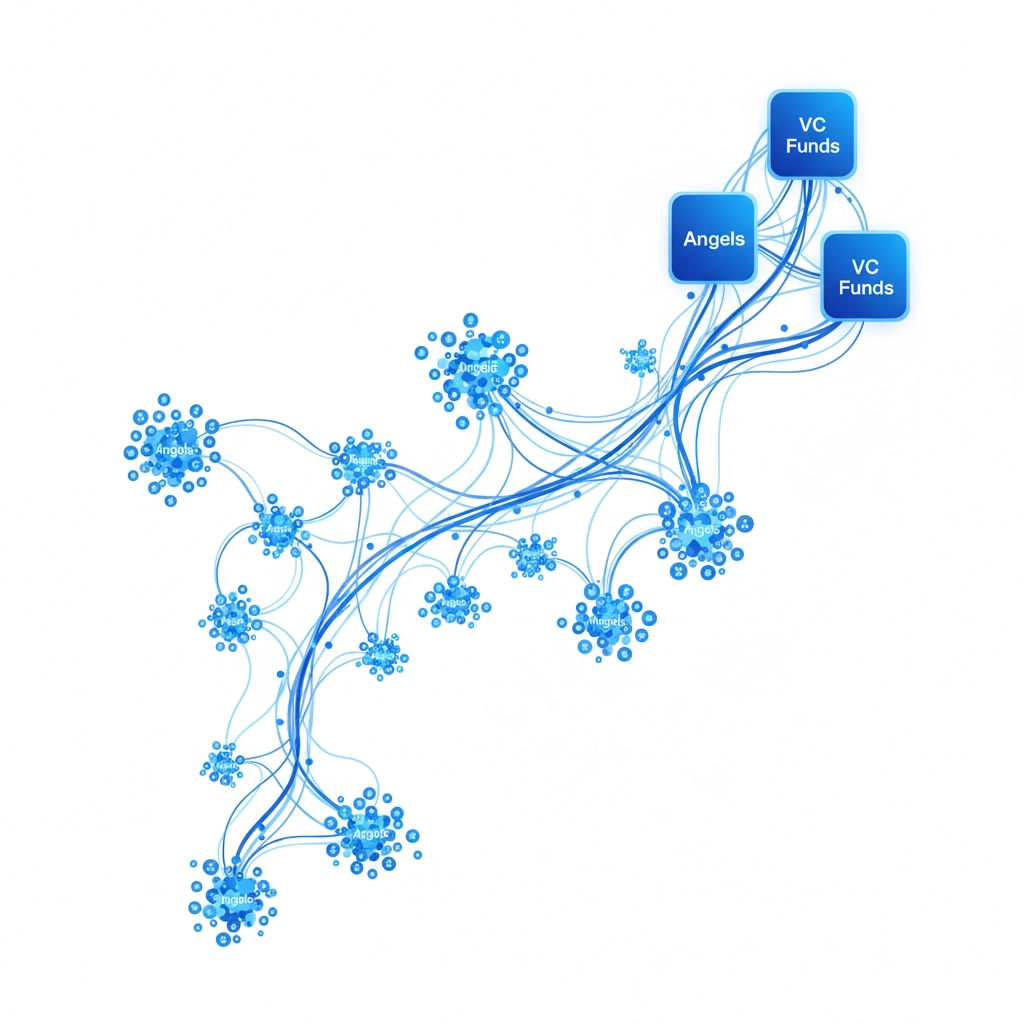
Even more interesting is the recent trend of angel groups syndicating with other angel groups and micro funds, creating "syndicates of syndicates" that can rival traditional VC fund investments in size. This evolution has blurred the traditional lines between angel and VC investing, creating new opportunities for founders at various stages.
The Blurring Lines
The distinction between angels and VCs has become increasingly complex as market dynamics shift. Large venture capital firms have moved downstream into earlier-stage deals, seeking to build relationships and secure pro rata rights with promising companies before the hypercompetitive Series A rounds: particularly evident in the current AI investment frenzy.
This strategic positioning allows VCs to establish relationships early and maintain the option to lead larger rounds as companies mature. Meanwhile, angels have moved upstream through group formation and syndication, allowing them to participate in larger deals traditionally reserved for institutional investors.
Decision-Making Processes and Speed
The structural differences between angels and VCs significantly impact decision-making speed and process:
Angels and Angel Groups often move faster due to fewer stakeholders and simpler decision trees. Individual angels might decide within weeks of meeting a founder, while angel groups typically operate on monthly or quarterly meeting schedules but can still move more quickly than institutional funds.
Venture Capital Funds require more extensive partner consensus, due diligence committees, and formal approval processes. This thoroughness comes at the cost of speed, with decisions often taking months rather than weeks.
Value-Add Beyond Capital
Both angels and VCs offer more than money, but their contributions differ in scope and style:
Angels provide industry expertise, mentorship, and personal networks built over decades of experience. Many are former entrepreneurs who offer practical, hands-on guidance during the critical early stages of company development. Their involvement is often more personal and relationship-driven.
Venture Capital Funds bring institutional resources, including portfolio company networks, recruitment assistance, strategic advisory services, and extensive professional networks. They often provide more systematic support through dedicated platform teams focused on helping portfolio companies scale operations, recruit talent, and navigate growth challenges.
Making the Right Choice for Your Startup
Consider Angel Investors When:
- You're in pre-seed or seed stages with minimal revenue
- You need capital under $1 million to prove concept and achieve initial traction
- You value speed and flexibility in the funding process
- You want investors who understand the entrepreneurial journey firsthand
- You're comfortable with less formal investor relationships
Consider Venture Capital When:
- You have demonstrated market traction and repeatable revenue streams
- You need significant capital ($3 million+) for scaling operations
- You require institutional credibility for customer acquisition or strategic partnerships
- You can benefit from systematic operational support and professional networks
- You're prepared for more formal board governance and investor relations
The Strategic Sequencing Approach
The most successful funding strategies often involve both angel and VC investors in sequence. Angels provide the initial capital and validation needed to achieve product-market fit and early traction metrics. This foundation then positions companies to attract institutional venture capital for scaling phases.
Consider angel groups as a bridge between individual angels and institutional VCs. They offer more substantial capital than individual investors while maintaining the entrepreneurial perspective and faster decision-making that characterizes angel investing.

For Potential Investors
If you're considering becoming an investor yourself, angel investing offers several advantages. Individual angel investing allows you to leverage personal expertise and industry knowledge while building relationships with innovative entrepreneurs. Joining an established angel group provides deal flow, shared due diligence, and collective wisdom while allowing you to participate in larger, potentially higher-quality opportunities.
The growing sophistication of angel groups means investors can now access deal quality and support structures previously available only through institutional funds, but with more direct engagement and faster decision-making.
The Current Market Reality
Today's funding landscape reflects this evolution. Angel groups frequently syndicate deals that reach traditional Series A sizes, while seed-stage VCs compete with angels for the most promising early-stage opportunities. This convergence creates more options for founders but also requires more sophisticated understanding of each investor type's motivations and capabilities.
The key is matching your company's specific needs, stage, and growth trajectory with the right type of capital partner. Whether you choose angels, VCs, or a strategic combination of both, understanding these differences will help you build the investor relationships that best support your startup's journey from concept to successful exit.
For founders in the Rocky Mountain region and beyond, the choice between angels and VCs isn't just about capital: it's about finding partners who understand your vision, can accelerate your growth, and share your commitment to building something remarkable.

.jpg)

.jpg)

